


Animals
The fauna of the Dakota Prairie Grasslands includes a diverse ecosystem that supports a wide variety of mammals, birds, reptiles, insects, and more. Here are a few examples of the various animals that call the prairie grasslands home. Before you go, download the Plant and Wildlife Checklist to help keep track of the flora and fauna you may spot in the grasslands.
Marvelous Mammals in the Grasslands
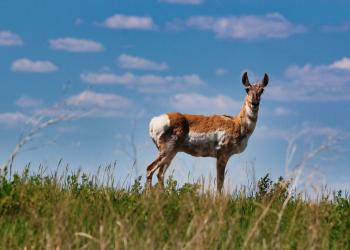
The Dakota Prairie Grasslands are home to various mammals, including herbivores like bison, elk, deer, and pronghorn, which graze on the grasses and plants. Smaller mammals like prairie dogs, voles, and other species prefer to live underground to avoid the trampling hooves of larger animals.
Click an image to view the photo gallery in full-screen size and read the descriptive captions.




Awesome Avian in the Grasslands
The Dakota Prairie Grasslands are home to a diverse and fascinating array of flighted fauna. Some species are perpetual prairie mainstays, while others are migratory, making the region a crucial breeding and stopover area. A few unique species are featured in the photo gallery below. A few other species are highlighted on the Birding in the Grasslands page. Also, the Grouse in the Grasslands page offers a grouse lekking photo gallery and an article spotlighting the sharp-tailed grouse.
Click an image to view the photo gallery in full-screen size and read the descriptive captions.


Western Burrowing Owls in the Grasslands
Western Burrowing Owls are small, ground-dwelling birds well-adapted to life on open grasslands and prairies and known for their unique living arrangements and daytime activities. These animals are included on the US Fish and Wildlife Service Bird Species of Concern list; therefore, hunters are prohibited from shooting them.
Click an image to view the photo gallery in full-screen size and read the descriptive captions.


Writhing Reptiles in the Grasslands
Reptiles in grasslands exhibit diverse adaptations to thrive in this environment, including camouflage, basking in the sun to regulate body temperature, specialized writhing locomotion, and prey-capture features. The scaly skin of reptiles is a defining characteristic that helps them survive in various terrestrial environments. The scales are made of keratin, a protein similar to that in human fingernails and hair, which protects them from abrasion and dehydration. These animals are crucial in the grasslands, controlling rodent and insect populations.
Click an image to view the photo gallery in full-screen size and read the descriptive captions.


Productive Pollinators in the Grasslands
In the Dakota Prairie Grasslands, a wide range of animals play a vital role in pollinating prairie wildflowers and grasses. Pollination involves moving pollen—the male reproductive cells of a plant—from one part of a flower to another, typically to the stigma, which enables fertilization and seed production. Animals known as pollinators visit flowers to collect pollen (a source of protein) and nectar (a source of carbohydrates). As they move from flower to flower, they inadvertently transfer pollen, helping plants reproduce.
More than 100,000 animal species—including bats, bees, flies, moths, beetles, birds, and butterflies—provide these essential pollination services at no cost. In fact, about one-third of the food we eat relies on plants pollinated by wild pollinators. The photo galleries below feature some of the most productive pollinators found in the grasslands.
Click an image to view the photo gallery in full-screen size and read the descriptive captions.


Bountiful Butterflies in the Grasslands
The Dakota Prairie grasslands support a diverse array of butterfly species. Butterfly distribution in these grasslands is strongly influenced by several factors, especially the presence and availability of suitable host plants, which are essential for their survival. Different butterfly species prefer specific types of prairie habitats, such as wet-mesic, dry, or tall-grass prairies. These grasslands are home to many butterflies, including various skippers like the Dakota and Ottoe, as well as more common species such as the cabbage white, Cloudless sulphur, and a variety of Tiger swallowtail.
Click an image to view the photo gallery in full-screen size and read the descriptive captions.


The Dakota Skipper in the Grasslands

A Dakota skipper rests on a flower in a garden, displaying its distinctive wing markings.
The Dakota Skipper is a small prairie butterfly, measuring about one inch across with clubbed antennae. Female Dakota Skippers have dark brown upper wings marked with tawny-orange and a few white spots along the edge of the forewing. The underside of their wings is gray and brown, featuring a faint white band across the middle.
This butterfly lives in native tall-grass and mixed-grass prairies, such as those found in the Dakota Prairie Grasslands.
Dakota Skipper populations have declined significantly. In 2014, the species was listed as threatened under the Endangered Species Act, and critical habitats were designated in McKenzie, Ransom, Richland, and Rolette Counties in North Dakota.
Dangerous Dakota Denizens in the Grasslands
Although the grasslands are amazing, serene, scenic, and stunning, all kinds of creatures, great and small, may still pose dangers. Visitors are encouraged to prepare and take precautions to defend themselves.
Contact the local Ranger District Office for more information.
Click an image to view the photo gallery in full-screen size and read the descriptive captions.


Explore Even More
Exotic and Invasive Species

Exotic species, also called non-native or non-indigenous species, are organisms introduced into areas outside their natural range that negatively impact the economy, environment, or human health and can disrupt local grassland ecosystems.
Prehistoric Animals in the Grasslands

Explore some of the fascinating, extinct animals that once prowled, grazed, and ruled what is now the Dakota Prairie Grasslands.